I Built an 86K AI Skill Directory in 10 Weeks. Here's Why I'm Changing Course.
Agent Skills Hub indexed 86,000 open-source AI skills in 10 weeks. Traffic grew fast. Revenue stayed at $0. Then I interviewed 15 users — and realized discovery was never the problem.
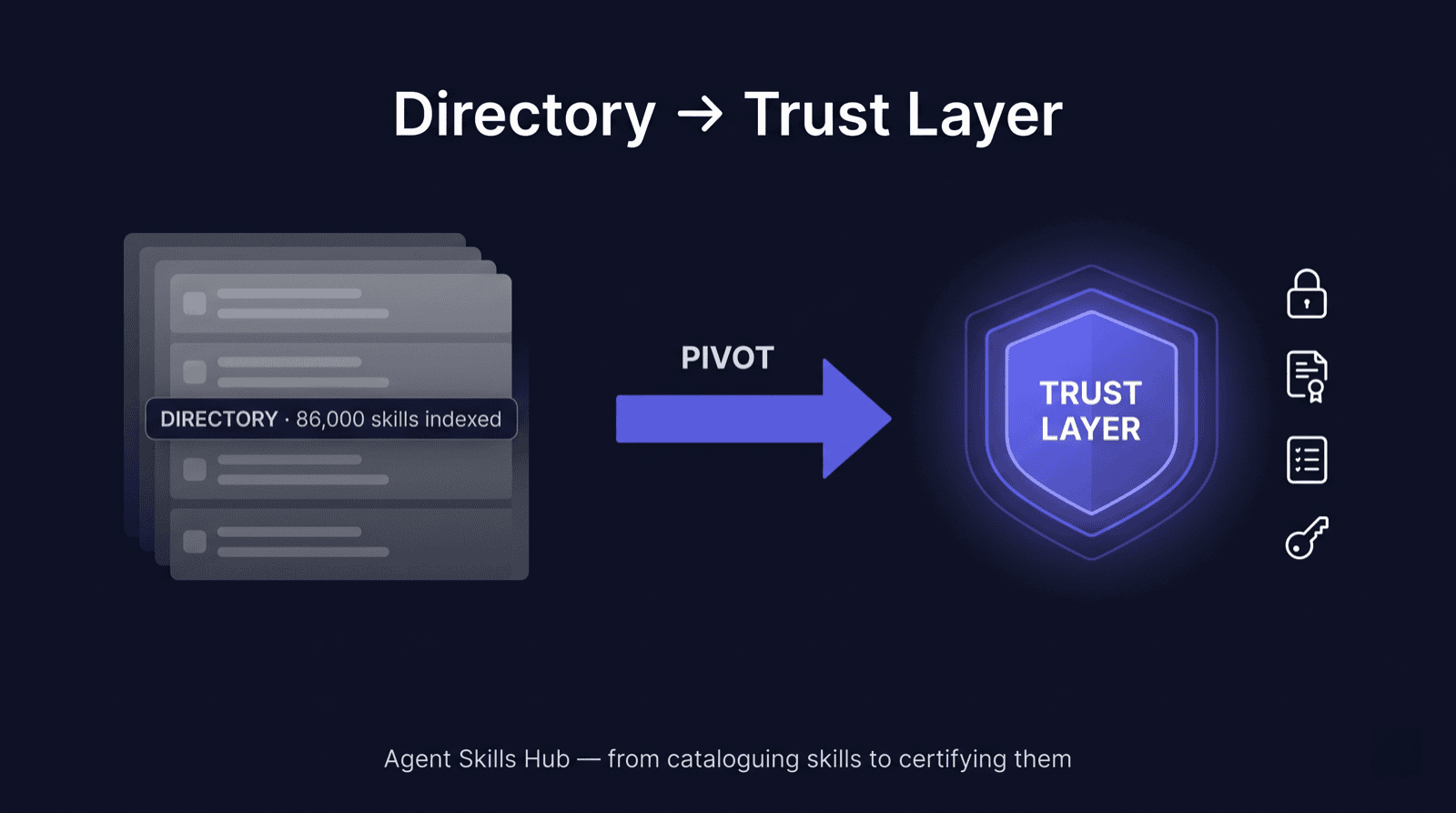
The Honest Admission
I launched Agent Skills Hub on March 8, 2026. Ten weeks later it had indexed 86,000+ open-source AI agent skills and MCP servers, scored every one of them across ten quality dimensions, and refreshed the whole catalog every eight hours.
The SEO traffic came faster than I expected — 60,000+ impressions in Google Search Console within those ten weeks, with category pages starting to rank on page one for real queries.
And the monthly revenue from all of it was exactly $0.
This post isn't a complaint. It's the opposite. The fact that one person could build an 86,000-item directory in ten weeks is precisely the thing that revealed the problem. Building the directory was fast. The directory just isn't worth much. Here's what I learned, and where Hub goes next.
The Directory Trap
The intuition that got me started was simple and wrong: more skills indexed = more value. If the catalog is the biggest and freshest, surely that's the moat.
It isn't. Directories — npm, the App Store, Product Hunt — are entry points, not products. Nobody pays the directory for the privilege of browsing it. The directory monetizes something downstream: hosting, distribution, trust, placement. The list itself is free because the list itself is cheap to make. Ten weeks of one person's time, in my case.
Worse, a pure directory leaves you stuck in the middle. Hub was too technical to become a consumer SEO tool site (the kind that earns ad revenue on a million monthly visits), and too lightweight to be a serious enterprise platform. It served the supply side of the open-source ecosystem — developers publishing skills — and that audience, by definition, doesn't pay. It contributes.
What 15 Interviews Told Me
So I stopped guessing and ran structured interviews: 5 independent developers, 5 enterprise decision-makers, and 5 skill creators, across the US, Germany, and China — spanning tech, healthcare, automotive, and logistics.
The three groups disagreed about almost everything. But on one point they were unanimous, and it wasn't the point I expected:
"Finding a skill is easy. Evaluating it, verifying it, deploying it safely — that's where all the friction is."
An independent developer and B2B SaaS founder put it bluntly: "Reliable doesn't mean it runs. It means when it breaks, the system doesn't go down with it. Avoiding one landmine is worth more than ten extra features."
An engineering VP at a large tech company: "The real blocker is identity, least-privilege, and a failure-rollback mechanism. Without those, nothing ships."
A German automotive technical decision-maker: "Compliance and auditability aren't a ranking question. They're a hard prerequisite."
The pattern is impossible to miss. People pay to remove risk, not to discover skills. Discovery is table stakes — the price of entry, not the value. Every dollar of willingness-to-pay in those interviews sat behind security, rollback, and audit. My directory was solving the one link in the chain nobody would pay for.
The Vulnerability Problem
Then I turned Hub's own scanners loose on the ecosystem it had been politely cataloguing. The result was uncomfortable.
Independent analysis puts the agent-skill vulnerability rate at 26.1% (Liu et al. 2026, arXiv:2601.10338) — prompt injection, credential leakage, sandbox-escape risk. Our own rule-based scan of the full catalog is deliberately more conservative, yet still flags 1 in 32 graded skills as outright unsafe. Either way, this is not an edge case.
It gets worse the closer you look. Connecting five MCP servers, each exposing ~30 tools, can burn 100K+ tokens of context before the agent does anything useful. And the stdio transport layer has a habit of returning 200 OK on actual errors — which means the model happily hallucinates on top of a failure it was never told about.
This is the part that reframed everything for me. "Hub has 86,000 skills" is not a value proposition. "Here are the skills in those 86,000 that are actually safe to put in production" — that is. That vulnerability rate isn't bad news for Hub. It's the moat. A skill that passes a real audit carries a scarce, provable trust premium. That premium is something enterprises will pay for, and creators will pay to earn.
The New Positioning
So, as of today, Agent Skills Hub stops describing itself as a directory. The new sentence — the one every page, pitch, and decision now anchors to:
Agent Skills Hub — the Trust Layer for AI Agent & MCP Deployment.
Concretely, that means Hub sits between your developers and your production environment, and provides four things:
- Pre-deployment sandbox — run a skill against de-identified, production-shaped data in isolation, with a kill switch on first anomaly.
- Compliance evidence pack — an auto-generated PDF mapping each skill to SOC 2 controls, ISO/IEC 42001 alignment, and EU AI Act 2026 risk classification. The document you hand your auditor.
- Full-chain audit logs — every tool call, data flow, and error replay, exportable to your SIEM.
- SSO/SCIM + fine-grained RBAC — Okta, Auth0, Azure AD ready; skill-level permissions.
The design principle, straight from the interviews: embed into the enterprise's existing workflow — IAM, CI/CD, SIEM — rather than asking the enterprise to adopt yet another platform.
What Changes, What Stays
If you've been using Hub as a free catalog, almost nothing changes for you:
| Stays the same | What's new / upgraded |
|---|---|
| 86K+ catalog stays free, forever | /enterprise/ — audit + compliance evidence pack |
| 8-hour refresh cycle | Verified Creator upgraded to deep technical audit |
| Open-source, MIT, transparent scoring | Blue Book rebuilt around hard metrics |
The Blue Book in particular needed honesty. Users told me they wanted it stripped of marketing leaderboards and rebuilt around reproducible hard data — vulnerability fix rate, mean time to recovery (MTTR), rollback rate, latency distribution. A leaderboard built on vibes has no commercial value. A benchmark built on logs does. So that's the rebuild.
The 18-Month Roadmap
Three phases, in order of who pays first:
- Phase 1 (months 0–3) — Trust infrastructure. The /enterprise/ MVP: SSO/SCIM, sandbox, audit log export, compliance evidence pack. Plus the deep-audit upgrade to Verified Creator. Target: first 3–5 enterprise POCs.
- Phase 2 (months 4–9) — Developer tooling. An IDE plugin (discover, test, version-lock in one flow) and the Arena rebuilt as a benchmark-testing platform with automated metrics instead of anonymous votes.
- Phase 3 (months 10–18) — Creator economy + international compliance. Multi-model creator monetization, plus SOC 2 Type II and ISO/IEC 42001 for Hub itself.
The Ask
If your team runs AI agents in production — and you've been blocked by compliance at launch, had a prompt-injection incident, or simply have no clean way to audit an MCP server before it ships — I want to talk to you.
Not to sell. To understand. A 30-minute call where we walk through your current setup and I show you three immediate risks before the call ends.
This blog is itself part of building in public. I'll publish an honest retrospective at the end of every phase — what worked, what didn't, what the numbers actually were. The next one of those will tell you whether this pivot was right.
Run AI agents in production?
Book a 30-minute call. We'll walk your current MCP/agent setup and surface three immediate risks — no slides, no sales theater.
See the Enterprise plan →Agent Skills Hub is an open-source project (MIT). The 86K catalog stays free. Methodology and data snapshots are documented at github.com/ZhuYansen/agent-skills-hub.